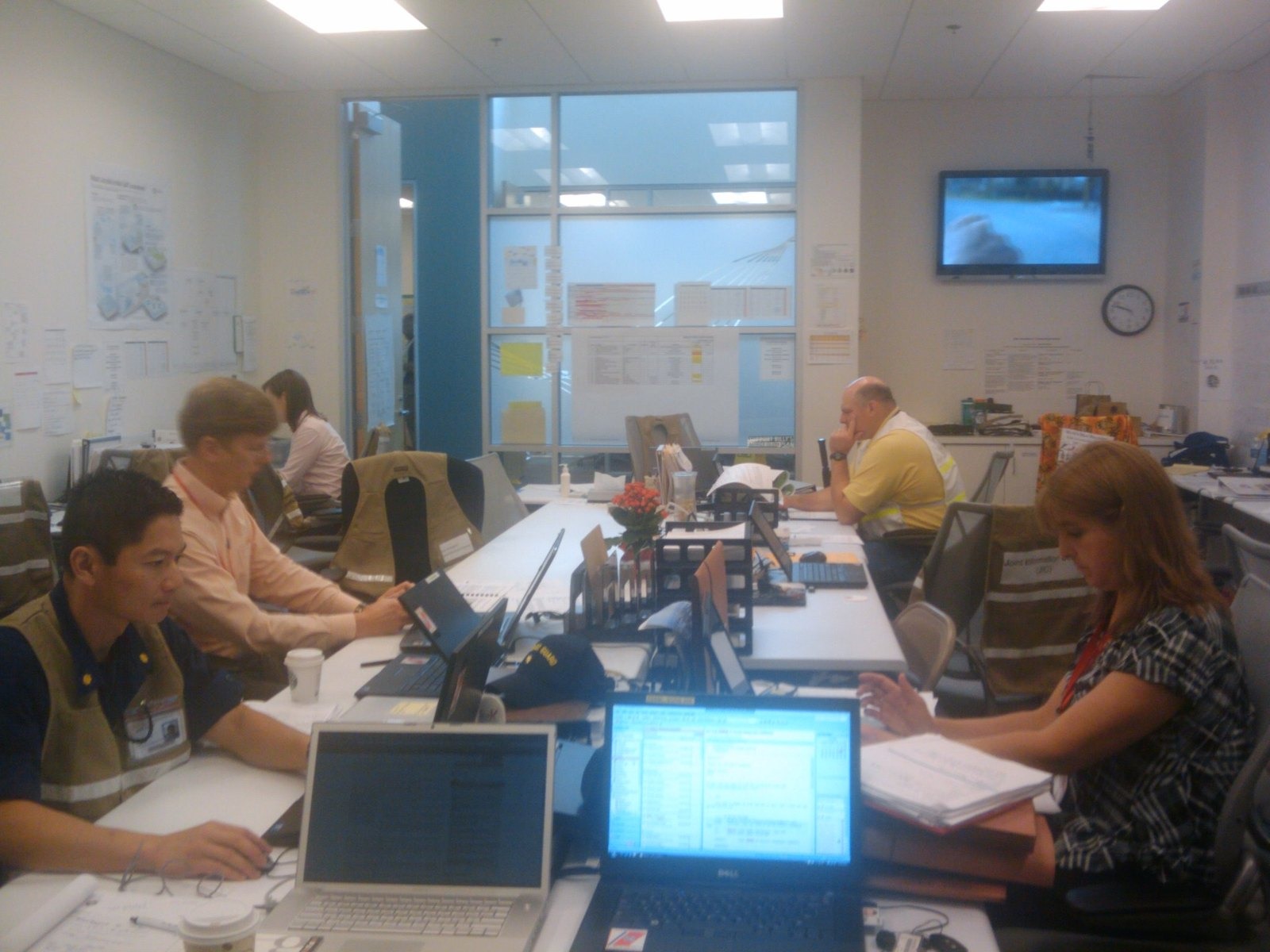
Deepwater Horizon: The National Strike Force Response
Feature written for the National Strike Force 2010 Year in Review, where I served as production editor and lead designer. Shown here from my full draft.
When the offshore oil platform Deepwater Horizon exploded in the Gulf of Mexico in April, the National Strike Force found itself at the center of one of the largest and most complex responses in U.S. history. The immense scale of the disaster required the NSF to rethink its approach to operations in order to combat the expansion of widespread environmental impact.
The Federal On-Scene Coordinator called upon the NSF within hours of the incident, and the NSF focused its collective effort on several fundamental strategies to clean up the seemingly unending flow of oil. These strategies were to capture the oil on the water’s surface, remove it from the water, and keep it away from environmentally sensitive areas.
“This is what we train for,” said Lt. Cmdr. Tedd Hutley, the NSF operations officer based at the National Strike Force Coordination Center in Elizabeth City, N.C. “Even though the magnitude of what we were dealing with was unprecedented, we were ready to apply our technical expertise, equipment and leadership for this spill.”
The Gulf Strike Team was the first NSF component to deploy to the region because the spill was located in its area of responsibility. It quickly became clear, however, that the response required personnel and equipment from all three strike teams and the NSFCC.
“Each component of the NSF has its own identity, areas of responsibility and unique capabilities,” said Hutley. “However, because we share a common vision and are standardized in our training and procedures, when we are faced with a large response like Deepwater Horizon, the team boundaries come down and we respond as one National Strike Force.”
A challenge that the NSF shared with the rest of the Coast Guard’s response units was that the spill occurred during the height of personnel transfer season, and some of the most experienced oil spill experts on scene were in the middle moving their families. For NSF members, this meant that nearly one third of its qualified members were transferred during the summer months, making the expectations of new personnel exceptionally high.
“New NSF members had to come up to speed very quickly,” said Hutley. “Our new people received initial core training, and then had to hit the decks running.”
Despite these challenges, NSF members provided support and filled supervisory roles in nearly every aspect of the response; ninety percent of the NSF’s 235 members deployed to the Gulf for at least one tour.
In addition to the resources deployed at the explosion site, nearly 17 staging areas were set up along the Gulf Coast to respond to reports of oil and protect sensitive shoreline areas, and the NSF played a pivotal role in five unique facets: in-situ burn, skimming operations, near-shore cleanup, resource management, and equipment reconstitution.
In Situ Burn
On April 28, NSF team members supervised the first in situ burn of surface oil since 1989 when responders conducted test burns during the Exxon Valdez spill. In situ burn, also known as controlled burn, proved to be highly effective in the Gulf and was used at the spill site throughout the response.
“Characteristics of this spill made in situ burning an extremely effective oil removal strategy,” said Hutley. “We had a continuous supply of product on the water that was suitable for burning and it was far away enough from shore to have minimal environmental impact.”
Though the in situ burn method is simple in concept, it required responders to be perfectly coordinated through every step of the process. From a command vessel, NSF strike team members supervised four task forces, each comprised of barge cranes, shrimp boats other and smaller boats, and dozens of crewmembers. When given the green light, two shrimp vessels towed flame-resistant boom between them in a U-shape, and pulled the trapped oil a safe distance to ignite it.
Responders faced inherent dangers during in situ burn operations. The crews endured excessively hot temperatures while wearing bulky personal protective equipment and had to fight against ocean waves to ignite the corralled oil.
Weather conditions also had a significant impact on in situ burn operations. Winds, sea state, and the oil’s concentration on the surface all had to complement each other in order for a burn to be successful.
“Some days it was too stormy, waves were too high, and conditions were better for dispersants,” said the Gulf Strike Team’s Petty Officer 1st Class Ken Bond, who was assigned as an in situ burn supervisor.
Despite the challenges, by November 13, more than 400 controlled burns were conducted, removing approximately 11 million gallons of oil. According to the National Commission on the BP Deepwater Horizon Oil Spill and Offshore Drilling final report to President Obama, this accounted for about five percent of the total oil spilled.
“The response showed just how viable it [in situ] is, and hopefully, it will be used on a much more frequent level in the future,” said Bond.
Skimming Operations
Another highly effective day-to-day method of oil recovery used during the Deepwater Horizon response was surface skimming. When weather was favorable, skimming operations collected approximately 63,000 gallons of oily-water mix a day. The NSF oversaw two types of surface skimming operations: the Vessel of Opportunity Skimming Systems (VOSS) and the Spilled Oil Recovery Systems (SORS).
The VOSS were installed aboard different types and sizes of contracted vessels. NSF personnel acted as team leaders aboard VOSS vessels and supervised crews of seven or eight people.
Petty Officer 1st Class Daniell Lashbrook with the Pacific Strike Team was assigned as lead supervisor for skimming operations on the 130-foot supply vessel Odyssey Mariner.
“This was the first time I had used the VOSS in a real-life scenario,” said Lashbrook. “When I first arrived to the response, I was assigned to a team with another strike force member and we had both only been with the NSF a year each. It was definitely a challenge to apply our training in such a massive operation.”
The SORS equipment is pre-staged around the U.S. onboard 225-foot Coast Guard buoy tenders, and those crews are required to train regularly on the system’s operation and deployment. SORS are usually kept in reserve and only brought out when commercial resources are limited. Deepwater Horizon was just such an occasion.
“The spill was so large that all available resources needed to be applied, including government-owned equipment,” said Hutley.
To ensure coordinated cleanup efforts, a command vessel directed teams of SORS and VOSS-equipped vessels to heavily-oiled areas, which were tracked daily during overflights. Reminiscent of an on-water SWAT team, skimming teams were in constant motion in the Gulf, when weather permitted, and communicated closely with each other in an effort to capture the maximum amount of oil.
“We would wait for the streamer of oil from the current and let the skimmer catch it,” said Lashbrook. “Oil was so thick we used a fire hose to push oil into the skimmer because there was often so much debris blocking it.”
Oiled boom and equipment combined with high heat and humidity presented constant dangers to the skimming teams. Vigilance was vital to avoid injuries.
“We worked long 12-hour days,” said Lashbrook. “We would start the day early and try to secure the decks by sunset. The decks were very dangerous at night because oil was everywhere.”
Near-Shore Cleanup
Sensitive coastlines along the entire Gulf Coast were at risk, and hundreds of miles of containment were deployed to corral the oil, collect it, or deflect it before it could damage marshlands, mangroves, and fishing areas.
Similar to the firehouse mindset of the skimming teams, the responders in charge of near shore cleanup operations wanted the ability to descend on affected areas as soon as reports came in. Near shore operations posed a significant challenge because the intrusion of man and man-made oil spill cleanup equipment could potentially cause as much – if not more – damage to delicate wetlands than the oil itself.
One solution came in the form of the Quick Reaction Force. QRFs have been used throughout history as part of war time strategy, and NSF members and the unified command designed a way to apply the QRF model to combat the encroachment of pollution during Deepwater Horizon.
Constructed for mobility and rapid response, QRFs were led by NSF members, and were comprised of rapid response equipment and experienced contractors qualified to operate it.
The NSF’s built-in ability to adapt to constantly changing environments was a perfect fit, said the Atlantic Strike Team’s Chief Petty Officer Bridgett Brown, who acted as a deputy operations section chief during Deepwater Horizon.
To be successful, the QRFs needed the freedom to move about independently to investigate reports of impacted areas, Brown said. Requiring QRFs to obtain multiple levels of approvals before shifting gears was counterproductive.
Fortunately, Brown said, the QRF teams were fully empowered through the command structure, largely due to the expertise of the NSF members supervising the operations.
The QRF was not exempt from staffing issues, Brown said.
“It was challenging to sustain enough NSF personnel in the positions as field supervisors for such a large and lengthy response,” she said.
In order to sustain the operations, the teams recruited heavily from reserve and prior NSF members to fill roles as QRF supervisors for each of the various missions in the field.
“The reliance on all NSF members, no matter the active duty, reserve or former NSF member status, played one of the most pivotal roles in the NSF's continued success,” said Brown. “The overwhelming success of the QRF teams throughout the various mission assignments proved the concept worked, and worked well.
In fact, according to Brown, news of the QRF concept spread, and in June, the NSF deployed on an EPA case, and the unified command of that response employed the same QRF concept.
Response Resource Inventory
The Deepwater Horizon response called for the deployment of millions of feet boom, thousands of vessels and skimmers, nearly a million gallons of dispersant as well as all of the resources needed to support the thousands of people involved with the cleanup effort. This widespread mobilization of resources created an extremely high demand for real-time resource information.
To meet this immense demand, the NSFCC used the Response Resource Inventory, an electronic database of the nation’s Oil Spill Removal Organizations and their available pollution response equipment.
“Early on in the Deepwater Horizon response, the RRI was particularly crucial to on-scene commanders looking for resources,” said Lt. Raymond Jackson, response support division chief at NSFCC, and the RRI administrator. “The RRI was used to identify available resources across the nation needed to combat the spill.”
Because of the huge demand for oil spill response equipment in the Gulf, Jackson said, the response resources that remained in each captain of the port zone were primarily supporting vessel and facility response plan holder regulatory requirements. Reallocation of resources to the Gulf would potentially impact the Maritime Transportation System and the donor region’s ability to comply with regulatory requirements and respond to additional pollution incidents.
To help combat this, the NSFCC created additional tools in the RRI to monitor resource capabilities across the country and help mitigate the impact of the unprecedented resource draw.
NSFCC members spent hundreds of hours conducting hands-on inspections of all the equipment listed in the RRI for all OSROs across the country to ensure the database was accurate.
In hindsight, Jackson believes the Deepwater Horizon disaster provided the much-needed impetus for further improving the RRI and increasing the awareness of its capabilities.
“The RRI is a planning and preparedness tool that is much more powerful than it has ever been,” Jackson said.
Prichard
Nearly all of the Coast Guard owned oil spill response equipment was put into action in the Gulf, and tracking, maintaining and repairing this equipment during response operations presented a significant hurdle. The Coast Guard needed to decontaminate and reconstitute its equipment to ensure its readiness was returned to pre-Deepwater Horizon levels.
Normally, Coast Guard equipment is not used in oil spill responses because the responsible party contracts OSROs to provide and operate equipment. This was the case with BP, but the staggering demand for equipment soon required the Coast Guard to bring its own response resources to bear.
“In this spill we used more Coast Guard equipment than any other response we have been involved with,” said Dale Hemenway, the equipment specialist at the NSFCC. “We needed every resource we could get.”
To overcome this hurdle, NSFCC personnel worked hand-in-hand with the unified area command in New Orleans to open the Coast Guard Central Maintenance Facility in Prichard, Ala.
The Prichard facility came online shortly after the wellhead was capped and the need for skimming operations subsided, but the need to decontaminate and restore the equipment grew. At 500,000 square feet, it was large enough that Hemenway and other staff had room to sort the thousands of pounds of equipment for either disposal, or repair and reconstitution.
“If we ever have an event like this in the future, it will be necessary to have a warehouse like the one in Prichard,” said Hemenway, who spent a total of six weeks there. “A lesson learned from this response is that we need to secure a facility immediately after a spill starts. It will help the Coast Guard maintain its readiness posture.”
Hemenway said without the facility, the equipment would not have gotten repaired or refurbished.
”Decontaminating and reconstituting the equipment after a spill is just as important as having it well-maintained and pre-staged,” he said.
Now that the emergency phase is over and the response is stabilized, NSF members continue to fill numerous roles to restore the Gulf to its pre-spill condition.
Hutley believes the Deepwater Horizon response allowed NSF members the opportunity to grow from successes and failures.
“This spill of national significance provided unprecedented on-the-job training with many lessons learned and best practices identified,” said Hutley. “What we have learned will make the NSF stronger and hopefully refocus the Coast Guard’s marine environmental response mission.”
But for Hutley, the significance goes deeper.
“This whole response has never been about the NSF or the Coast Guard or any other responder,” said Hutley, “It’s been about carrying out our responsibilities to the American public under the National Contingency Plan and making sure the people of the Gulf know that we are committed to this response for the long haul.”
Post a comment